Northern Zigzag Salamander
Plethodon dorsalis
The Northern Zigzag Salamander (Plethodon dorsalis) is a salamander in the family Plethodontidae. USGS maps its range in 5 of the lower 48 states, most widely in Kentucky, where it covers 60% of the state. Adults reach up to 4.4 in (111 mm) in body length.
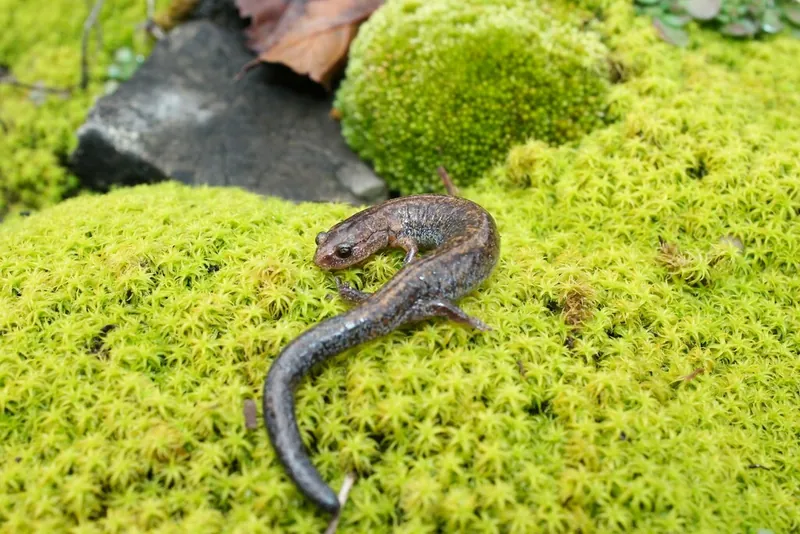
It lives on the ground and in water.
The USGS habitat model maps it in 5 land-cover types, among them South-Central Interior Mesophytic Forest, Southern Interior Low Plateau Dry-Mesic Oak Forest and East Gulf Coastal Plain Northern Loess Plain Oak-Hickory Upland.
Open-licence records from the lower 48 (3,497 of them) peak in March and are fewest in September. A clutch can hold up to 9 eggs.
By size, range and water use in the USGS models, the species most easily taken for it are the Southern Red-backed Salamander, the Green Salamander and the Southern Ravine Salamander.
Where the Northern Zigzag Salamander lives
| State | Share of state | Counties | Open records | Peak month |
|---|---|---|---|---|
| Kentucky | 60% | 75 of 120 | 760 | March |
| Tennessee | 35% | 43 of 95 | 574 | March |
| Indiana | 27% | 34 of 92 | 1,647 | October |
| Illinois | 5% | 11 of 102 | 813 | March |
| Missouri | under 1% | 2 of 115 | 34 | March |
Share of state is the part of each state inside the range map. Counties counts those with at least a tenth of their area in range. A state link opens that state's full list.
When it is recorded
Species it can be taken for
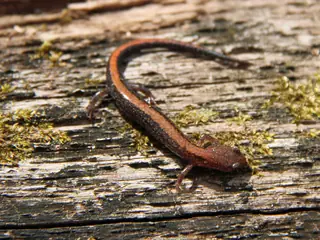
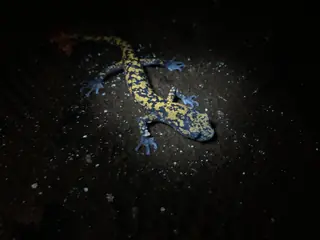
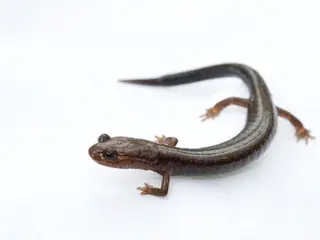
Chosen by rule: the same group, an adult size within 30%, at least one shared state and the same water use in the USGS habitat models. It is a list of candidates, not an identification.
Sources
- AmphiBIO v1. CC BY 4.0. Read 2026-11-15.
- GBIF Backbone Taxonomy. CC BY 4.0. Read 2026-11-15.
- GBIF occurrence records under CC0 and CC BY 4.0. CC0 and CC BY 4.0 per record. Read 2026-11-15.
- Integrated Taxonomic Information System. CC0. Read 2026-11-15.
- US Census Bureau cartographic boundary files 2023. Public domain (US Census Bureau). Read 2026-11-15.
- USGS GAP 12-digit hydrologic unit range units. Public domain (USGS). Read 2026-11-15.
- USGS Gap Analysis Project Species Habitat Maps CONUS_2001 (model parameters). Public domain (USGS). Read 2026-11-15.
- USGS Gap Analysis Project Species Range Maps CONUS_2001. Public domain (USGS). Read 2026-11-15.
- iNaturalist photographs under CC0 and CC BY. CC0 and CC BY per photograph. Read 2026-11-15.
How each figure is derived is set out on the methods page.