Treefrogs in New Jersey
3 species of treefrogs have a mapped range in New Jersey. The most widespread is the Cope's Gray Treefrog, mapped across all of the state.
The most restricted is the Barking Treefrog, mapped in 1% of the state.
The longest is the Barking Treefrog, at 2.8 in (70 mm); the shortest is the Gray Treefrog, at 2.4 in (60 mm).
The most species are mapped in Salem County (3); the fewest in Atlantic County (2).
The most often recorded is the Gray Treefrog, with 257 open-licence records in the state.
By the trait records, 2 are active at night and 1 is active by day and by night.
- Cope's Gray Treefrog
- Gray Treefrog
- Barking Treefrog
| Species | Size | Share of New Jersey | Active | Records | |
|---|---|---|---|---|---|
 | Cope's Gray Treefrog Dryophytes chrysoscelis Hylidae | 2.4 in (62 mm) body | all | day and night | 40 |
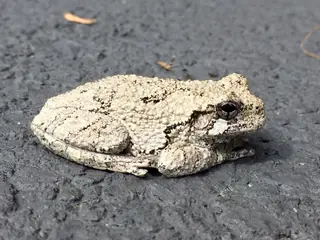 | Gray Treefrog Dryophytes versicolor Hylidae | 2.4 in (60 mm) body | all | night | 257 |
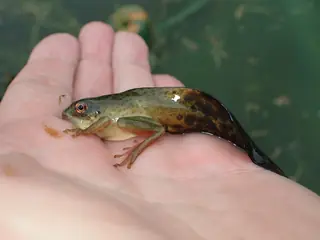 | Barking Treefrog Dryophytes gratiosus Hylidae | 2.8 in (70 mm) body | 1% | night | 10 |
Share of New Jersey is the part of the state inside the species' USGS range map. Size is the largest on record where the source gives a maximum, otherwise a typical adult. Records are open-licence observations and specimens in the state; a blank means none were counted, not that the species is absent.
More New Jersey lists
Other groups in New Jersey
Treefrogs in nearby states
Sources
- AmphiBIO v1. CC BY 4.0. Read 2026-11-15.
- GBIF Backbone Taxonomy. CC BY 4.0. Read 2026-11-15.
- GBIF occurrence records under CC0 and CC BY 4.0. CC0 and CC BY 4.0 per record. Read 2026-11-15.
- US Census Bureau cartographic boundary files 2023. Public domain (US Census Bureau). Read 2026-11-15.
- USGS GAP 12-digit hydrologic unit range units. Public domain (USGS). Read 2026-11-15.
- USGS Gap Analysis Project Species Range Maps CONUS_2001. Public domain (USGS). Read 2026-11-15.
- iNaturalist photographs under CC0 and CC BY. CC0 and CC BY per photograph. Read 2026-11-15.
How each figure is derived is set out on the methods page.