Hawks, eagles and falcons in Tennessee
12 species of hawks, eagles and falcons have a mapped range in Tennessee. 8 are mapped across the whole state, among them the American Kestrel, the Broad-winged Hawk and the Cooper's Hawk.
The most restricted is the Peregrine Falcon, mapped in 6% of the state.
The heaviest is the Bald Eagle, at 10.4 lb (4.7 kg); the lightest is the American Kestrel, at 4.0 oz (115 g).
Of these, 5 are mapped year-round, 4 in summer only, 2 in winter only and 1 on migration only.
The most species are mapped in Weakley County (11); the fewest in Hancock County (8).
Open-licence records in the state (2,119 of them) peak in May and are fewest in September.
The most often recorded is the Red-tailed Hawk, with 671 open-licence records in the state.
They belong to 3 families; the largest here is Accipitridae, with 8 species.
- 8
- 9
- 10
- 11
| Species | Size | Share of Tennessee | Active | Records | |
|---|---|---|---|---|---|
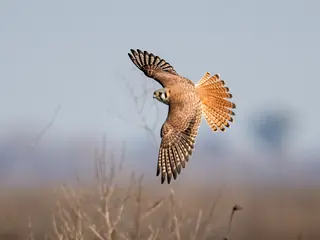 | American Kestrel Falco sparverius Falconidae | 4.0 oz (115 g) | all | day | 184 |
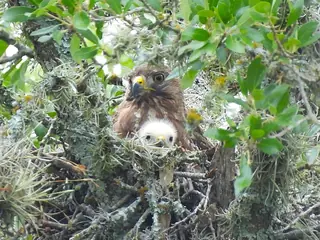 | Broad-winged Hawk summer Buteo platypterus Accipitridae | 1.0 lb (0.5 kg) | all | day | 92 |
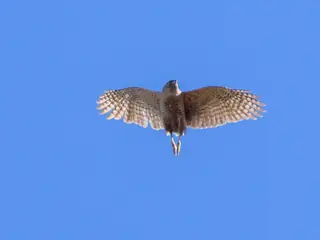 | Cooper's Hawk Accipiter cooperii Accipitridae | 15.2 oz (430 g) | all | day | 29 |
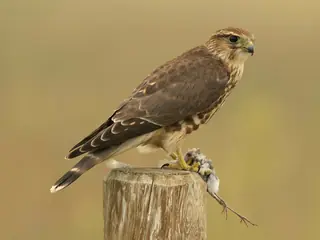 | Merlin migration Falco columbarius Falconidae | 6.6 oz (188 g) | all | day | 15 |
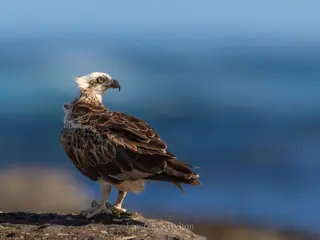 | Osprey summer Pandion haliaetus Pandionidae | 3.3 lb (1.5 kg) | all | day | 235 |
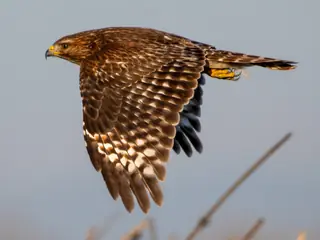 | Red-shouldered Hawk Buteo lineatus Accipitridae | 1.3 lb (0.6 kg) | all | day | 484 |
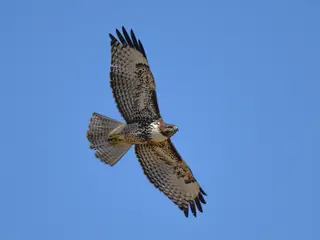 | Red-tailed Hawk Buteo jamaicensis Accipitridae | 2.4 lb (1.1 kg) | all | day | 671 |
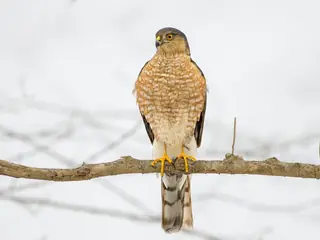 | Sharp-shinned Hawk Accipiter striatus Accipitridae | 4.6 oz (131 g) | all | day | 57 |
 | Bald Eagle winter Haliaeetus leucocephalus Accipitridae | 10.4 lb (4.7 kg) | 87% | day | 289 |
 | Northern Harrier winter Circus cyaneus Accipitridae | 13.9 oz (393 g) | 80% | day | 85 |
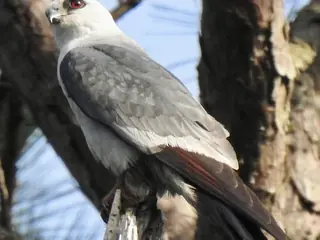 | Mississippi Kite summer Ictinia mississippiensis Accipitridae | 9.7 oz (276 g) | 15% | day | 84 |
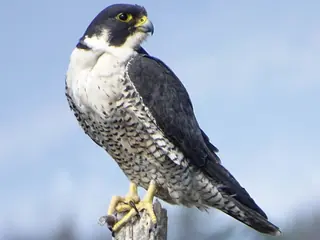 | Peregrine Falcon summer Falco peregrinus Falconidae | 1.7 lb (0.8 kg) | 6% | day | 22 |
Share of Tennessee is the part of the state inside the species' USGS range map. Size is the largest on record where the source gives a maximum, otherwise a typical adult. Records are open-licence observations and specimens in the state, with eBird left out; a blank means none were counted, not that the species is absent.
More Tennessee lists
Other groups in Tennessee
Hawks, eagles and falcons in nearby states
Sources
- AVONET: morphological ecological and geographical data for all birds. CC BY 4.0. Read 2026-11-15.
- EltonTraits 1.0. CC0. Read 2026-11-15.
- GBIF Backbone Taxonomy. CC BY 4.0. Read 2026-11-15.
- GBIF occurrence records under CC0 and CC BY 4.0. CC0 and CC BY 4.0 per record. Read 2026-11-15.
- US Census Bureau cartographic boundary files 2023. Public domain (US Census Bureau). Read 2026-11-15.
- USGS GAP 12-digit hydrologic unit range units. Public domain (USGS). Read 2026-11-15.
- USGS Gap Analysis Project Species Range Maps CONUS_2001. Public domain (USGS). Read 2026-11-15.
- iNaturalist photographs under CC0 and CC BY. CC0 and CC BY per photograph. Read 2026-11-15.
How each figure is derived is set out on the methods page.