Frogs and toads in Virginia
27 species of frogs and toads have a mapped range in Virginia. 4 are mapped across the whole state, among them the American Bullfrog, the Cope's Gray Treefrog and the Green Frog.
The most restricted is the Northern Leopard Frog, mapped in 2% of the state.
The longest is the American Bullfrog, at 8.0 in (203 mm); the shortest is the Little Grass Frog, at 0.7 in (18 mm).
The most species are mapped in Virginia Beach city (22); the fewest in Dickenson County (9).
Open-licence records in the state (24,752 of them) peak in July and are fewest in December.
The most often recorded is the Spring Peeper, with 2,733 open-licence records in the state.
By the trait records, 11 are active by day and by night and 8 are active at night.
They belong to 5 families; the largest here is Hylidae, with 14 species.
- 9 to 11
- 12 to 14
- 15 to 16
- 17 to 19
- 20 to 22
| Species | Size | Share of Virginia | Active | Records | |
|---|---|---|---|---|---|
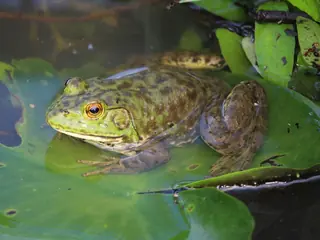 | American Bullfrog Lithobates catesbeianus Ranidae | 8.0 in (203 mm) body | all | day and night | 1,606 |
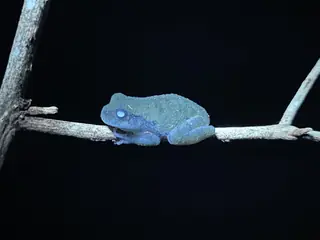 | Cope's Gray Treefrog Dryophytes chrysoscelis Hylidae | 2.4 in (62 mm) body | all | day and night | 1,399 |
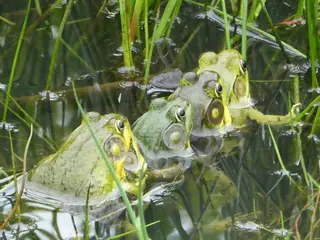 | Green Frog Lithobates clamitans Ranidae | 3.4 in (87 mm) body | all | day and night | 2,571 |
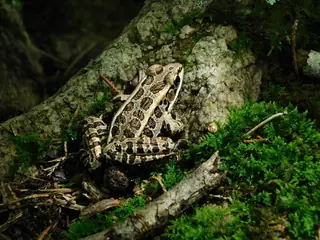 | Pickerel Frog Lithobates palustris Ranidae | 3.4 in (87 mm) body | all | 822 | |
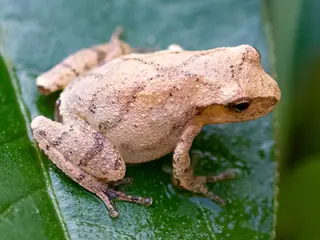 | Spring Peeper Pseudacris crucifer Hylidae | 1.5 in (37 mm) body | 96% | night | 2,733 |
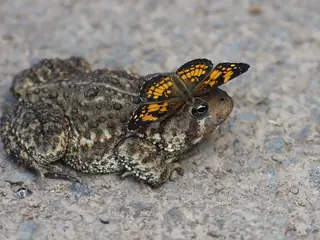 | American Toad Anaxyrus americanus Bufonidae | 4.4 in (111 mm) body | 94% | night | 2,364 |
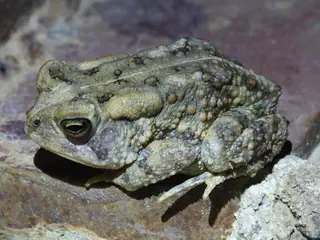 | Fowler's Toad Anaxyrus fowleri Bufonidae | 3.7 in (95 mm) body | 91% | 2,292 | |
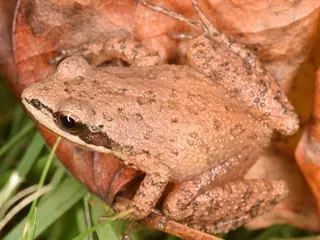 | Upland Chorus Frog Pseudacris feriarum Hylidae | 1.5 in (38 mm) body | 85% | day and night | 735 |
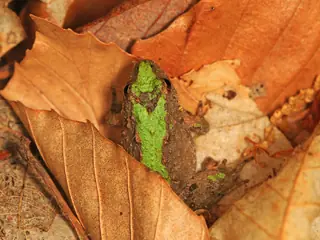 | Northern Cricket Frog Acris crepitans Hylidae | 1.5 in (38 mm) body | 83% | day and night | 2,082 |
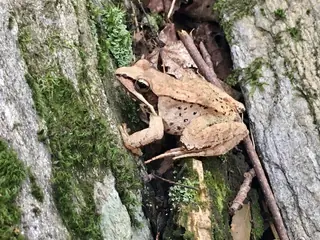 | Wood Frog Lithobates sylvaticus Ranidae | 3.3 in (83 mm) body | 67% | 1,168 | |
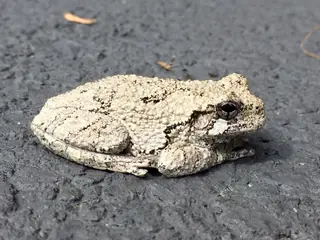 | Gray Treefrog Dryophytes versicolor Hylidae | 2.4 in (60 mm) body | 66% | night | 480 |
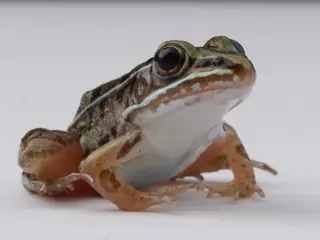 | Southern Leopard Frog Lithobates sphenocephalus Ranidae | 5.0 in (127 mm) body | 52% | 2,621 | |
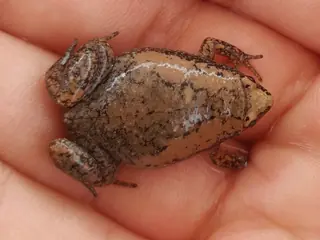 | Eastern Narrow-mouthed Toad Gastrophryne carolinensis Microhylidae | 1.5 in (38 mm) body | 51% | night | 537 |
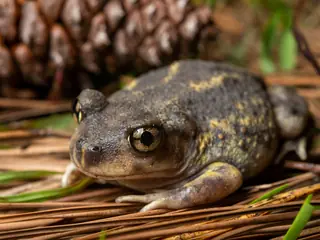 | Eastern Spadefoot Scaphiopus holbrookii Scaphiopodidae | 2.8 in (71 mm) body | 41% | night | 593 |
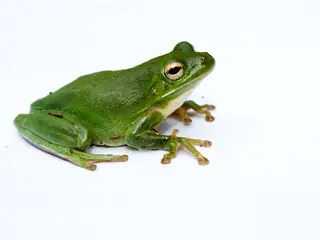 | Green Treefrog Dryophytes cinereus Hylidae | 2.6 in (66 mm) body | 26% | day and night | 1,349 |
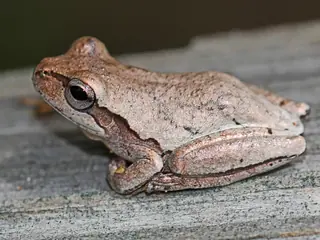 | Pine Woods Treefrog Hyla femoralis Hylidae | 1.7 in (44 mm) body | 17% | day and night | 542 |
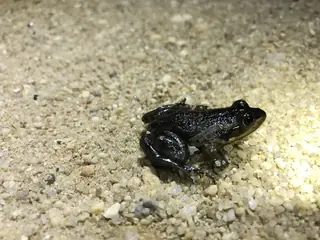 | Carpenter Frog Lithobates virgatipes Ranidae | 2.6 in (67 mm) body | 16% | 106 | |
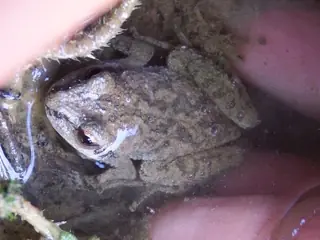 | Mountain Chorus Frog Pseudacris brachyphona Hylidae | 1.5 in (38 mm) body | 14% | night | 40 |
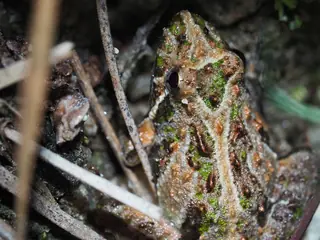 | Southern Cricket Frog Acris gryllus Hylidae | 1.3 in (32 mm) body | 14% | day and night | 628 |
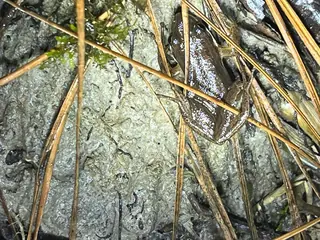 | Brimley's Chorus Frog Pseudacris brimleyi Hylidae | 1.4 in (35 mm) body | 13% | day and night | 297 |
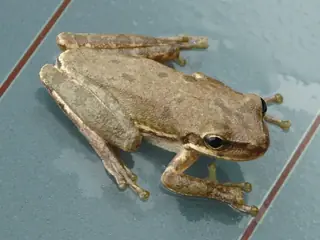 | Squirrel Treefrog Dryophytes squirellus Hylidae | 1.8 in (45 mm) body | 13% | night | 448 |
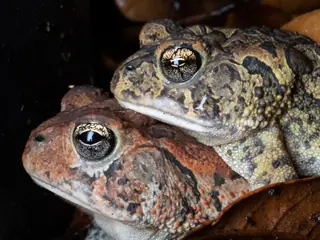 | Southern Toad Anaxyrus terrestris Bufonidae | 4.6 in (116 mm) body | 12% | 1,243 | |
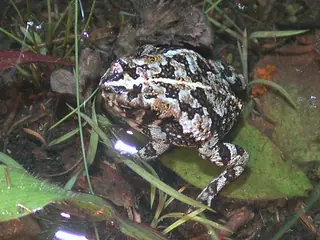 | Oak Toad Anaxyrus quercicus Bufonidae | 1.3 in (33 mm) body | 7% | 10 | |
 | Little Grass Frog Pseudacris ocularis Hylidae | 0.7 in (18 mm) body | 6% | day and night | 93 |
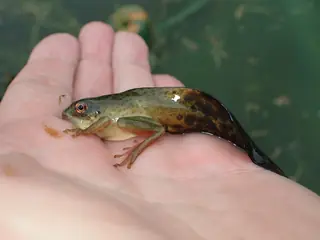 | Barking Treefrog Dryophytes gratiosus Hylidae | 2.8 in (70 mm) body | 6% | night | 71 |
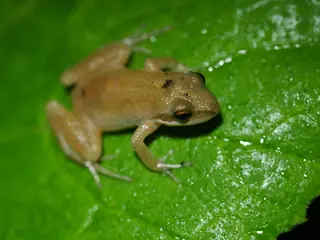 | New Jersey Chorus Frog Pseudacris kalmi Hylidae | 1.4 in (36 mm) body | 2% | day and night | 37 |
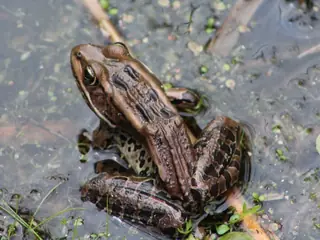 | Northern Leopard Frog Lithobates pipiens Ranidae | 6.5 in (165 mm) body | 2% | 2 |
Share of Virginia is the part of the state inside the species' USGS range map. Size is the largest on record where the source gives a maximum, otherwise a typical adult. Records are open-licence observations and specimens in the state; a blank means none were counted, not that the species is absent.
More Virginia lists
Other groups in Virginia
Frogs and toads in nearby states
Sources
- AmphiBIO v1. CC BY 4.0. Read 2026-11-15.
- GBIF Backbone Taxonomy. CC BY 4.0. Read 2026-11-15.
- GBIF occurrence records under CC0 and CC BY 4.0. CC0 and CC BY 4.0 per record. Read 2026-11-15.
- US Census Bureau cartographic boundary files 2023. Public domain (US Census Bureau). Read 2026-11-15.
- USGS GAP 12-digit hydrologic unit range units. Public domain (USGS). Read 2026-11-15.
- USGS Gap Analysis Project Species Range Maps CONUS_2001. Public domain (USGS). Read 2026-11-15.
- iNaturalist photographs under CC0 and CC BY. CC0 and CC BY per photograph. Read 2026-11-15.
How each figure is derived is set out on the methods page.