Herons and egrets in Kansas
10 species of herons and egrets have a mapped range in Kansas. 6 are mapped across the whole state, among them the American Bittern, the Black-crowned Night-heron and the Cattle Egret.
The most restricted is the Least Bittern, mapped in 8% of the state.
The heaviest is the Great Blue Heron, at 5.6 lb (2.5 kg); the lightest is the Least Bittern, at 3.0 oz (86 g).
Of these, 1 are mapped year-round, 4 in summer only and 5 on migration only.
The most species are mapped in Wyandotte County (10); the fewest in Cheyenne County (6).
Open-licence records in the state (1,262 of them) peak in June and are fewest in January.
The most often recorded is the Great Blue Heron, with 536 open-licence records in the state.
- 6
- 7
- 8
- 9
- 10
| Species | Size | Share of Kansas | Active | Records | |
|---|---|---|---|---|---|
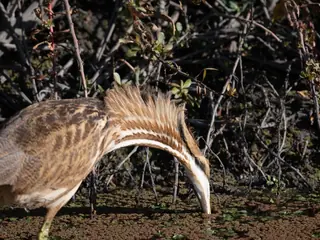 | American Bittern migration Botaurus lentiginosus Ardeidae | 1.6 lb (0.7 kg) | all | day | 144 |
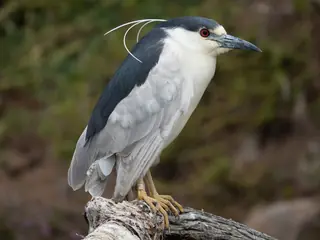 | Black-crowned Night-heron summer Nycticorax nycticorax Ardeidae | 1.8 lb (0.8 kg) | all | day | 156 |
| Cattle Egret summer Bubulcus ibis Ardeidae | 12.9 oz (366 g) | all | day | 13 | |
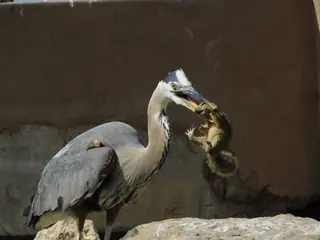 | Great Blue Heron Ardea herodias Ardeidae | 5.6 lb (2.5 kg) | all | day | 536 |
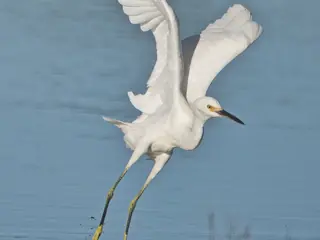 | Snowy Egret migration Egretta thula Ardeidae | 13.1 oz (371 g) | all | day | 46 |
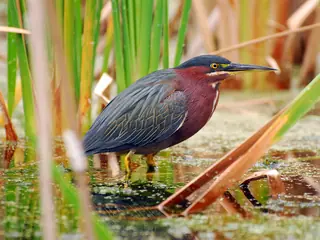 | Green Heron summer Butorides virescens Ardeidae | 7.1 oz (202 g) | all | day | 353 |
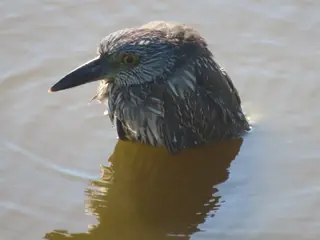 | Yellow-crowned Night-heron migration Nyctanassa violacea Ardeidae | 1.5 lb (0.7 kg) | 97% | day | 108 |
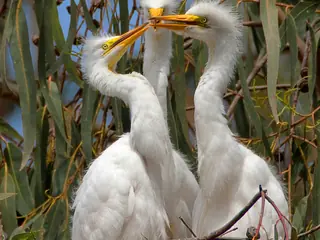 | Great Egret migration Ardea alba Ardeidae | 1.9 lb (0.9 kg) | 76% | 159 | |
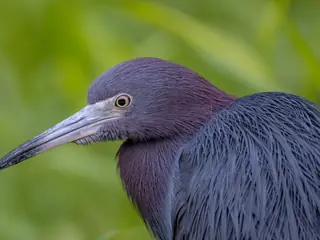 | Little Blue Heron migration Egretta caerulea Ardeidae | 11.9 oz (339 g) | 72% | day | 96 |
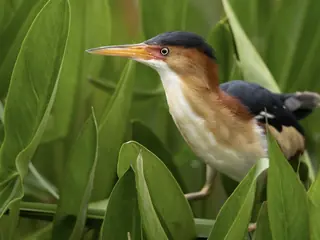 | Least Bittern summer Ixobrychus exilis Ardeidae | 3.0 oz (86 g) | 8% | day | 64 |
Share of Kansas is the part of the state inside the species' USGS range map. Size is the largest on record where the source gives a maximum, otherwise a typical adult. Records are open-licence observations and specimens in the state, with eBird left out; a blank means none were counted, not that the species is absent.
More Kansas lists
Other groups in Kansas
Herons and egrets in nearby states
Sources
- AVONET: morphological ecological and geographical data for all birds. CC BY 4.0. Read 2026-11-15.
- EltonTraits 1.0. CC0. Read 2026-11-15.
- GBIF Backbone Taxonomy. CC BY 4.0. Read 2026-11-15.
- GBIF occurrence records under CC0 and CC BY 4.0. CC0 and CC BY 4.0 per record. Read 2026-11-15.
- US Census Bureau cartographic boundary files 2023. Public domain (US Census Bureau). Read 2026-11-15.
- USGS GAP 12-digit hydrologic unit range units. Public domain (USGS). Read 2026-11-15.
- USGS Gap Analysis Project Species Range Maps CONUS_2001. Public domain (USGS). Read 2026-11-15.
- iNaturalist photographs under CC0 and CC BY. CC0 and CC BY per photograph. Read 2026-11-15.
How each figure is derived is set out on the methods page.