Siskiyou Chipmunk
Tamias siskiyou
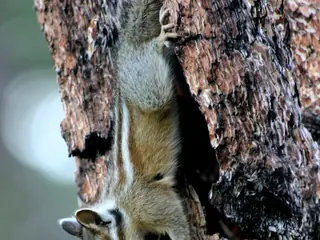
The Siskiyou Chipmunk (Tamias siskiyou) is a mammal in the family Sciuridae. USGS maps its range in 2 of the lower 48 states, most widely in Oregon, where it covers 10% of the state. Adults measure about 5.7 in (145 mm) in body length and weigh about 2.6 oz (75 g).
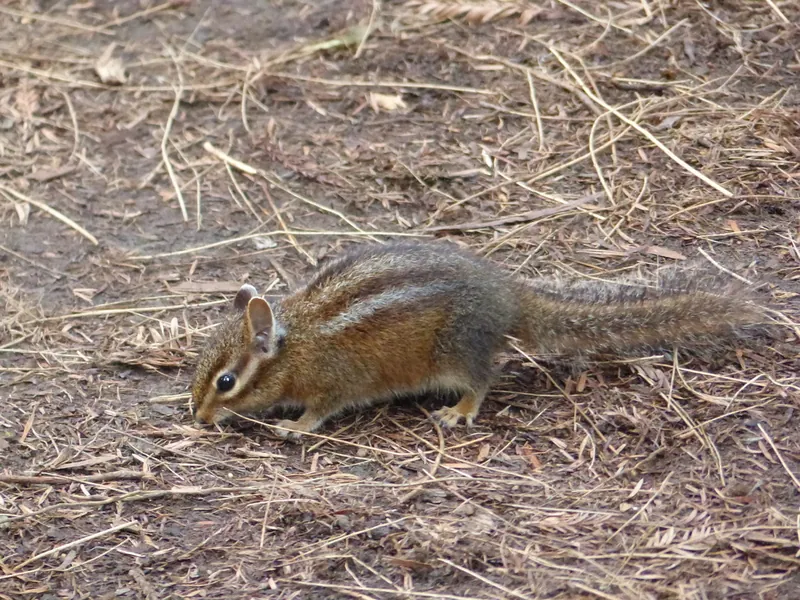
It is active by day.
The USGS habitat model maps it in 18 land-cover types, among them North Pacific Dry-Mesic Silver Fir-Western Hemlock-Douglas-fir Forest, North Pacific Dry Douglas-fir-(Madrone) Forest and Woodland and North Pacific Lowland Mixed Hardwood-Conifer Forest and Woodland. The model places it no higher than 2,000 m (6,600 ft).
Open-licence records from the lower 48 (916 of them) peak in September and are fewest in January. A typical litter is about 4.2. The longest recorded lifespan is 10.2 years.
By size, range and water use in the USGS models, the species most easily taken for it are the Shadow Chipmunk, the White-tailed Antelope Squirrel, the Yellow-pine Chipmunk and the Long-eared Chipmunk.
Where the Siskiyou Chipmunk lives
| State | Share of state | Counties | Open records | Peak month |
|---|---|---|---|---|
| Oregon | 10% | 7 of 36 | 392 | September |
| California | 2% | 2 of 58 | 529 | June |
Share of state is the part of each state inside the range map. Counties counts those with at least a tenth of their area in range. A state link opens that state's full list.
When it is recorded
Species it can be taken for
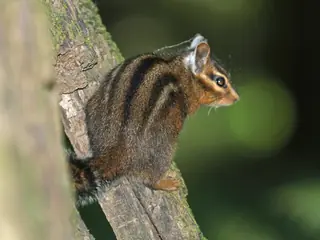
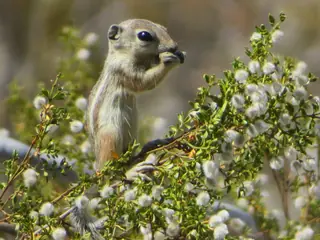
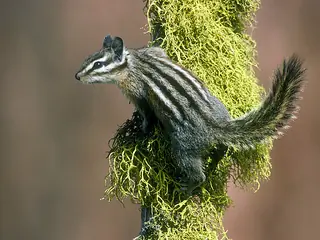
Chosen by rule: the same group, an adult size within 30%, at least one shared state and the same water use in the USGS habitat models. It is a list of candidates, not an identification.
Lists it appears on
Sources
- Amniote life-history database. CC0. Read 2026-11-15.
- EltonTraits 1.0. CC0. Read 2026-11-15.
- GBIF Backbone Taxonomy. CC BY 4.0. Read 2026-11-15.
- GBIF occurrence records under CC0 and CC BY 4.0. CC0 and CC BY 4.0 per record. Read 2026-11-15.
- Integrated Taxonomic Information System. CC0. Read 2026-11-15.
- PanTHERIA 1.0. CC0. Read 2026-11-15.
- US Census Bureau cartographic boundary files 2023. Public domain (US Census Bureau). Read 2026-11-15.
- USGS GAP 12-digit hydrologic unit range units. Public domain (USGS). Read 2026-11-15.
- USGS Gap Analysis Project Species Habitat Maps CONUS_2001 (model parameters). Public domain (USGS). Read 2026-11-15.
- USGS Gap Analysis Project Species Range Maps CONUS_2001. Public domain (USGS). Read 2026-11-15.
- iNaturalist photographs under CC0 and CC BY. CC0 and CC BY per photograph. Read 2026-11-15.
How each figure is derived is set out on the methods page.