Gulls and terns in California
22 species of gulls and terns have a mapped range in California. 4 are mapped across the whole state, among them the California Gull, the Herring Gull and the Ring-billed Gull.
The most restricted is the Franklin's Gull, mapped in under 1% of the state.
The heaviest is the Yellow-footed Gull, at 2.9 lb (1.3 kg); the lightest is the Least Tern, at 1.6 oz (46 g).
Of these, 3 are mapped year-round, 4 in summer only, 6 in winter only and 9 on migration only.
The most species are mapped in Ventura County (17); the fewest in Mariposa County (5).
Open-licence records in the state (56,932 of them) peak in June and are fewest in February.
The most often recorded is the Least Tern, with 68,252 open-licence records in the state.
- 5 to 6
- 7 to 8
- 9 to 11
- 12 to 14
- 15 to 17
| Species | Size | Share of California | Active | Records | |
|---|---|---|---|---|---|
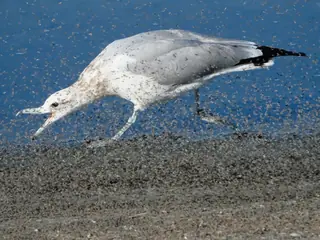 | California Gull migration Larus californicus Laridae | 1.5 lb (0.7 kg) | all | day | 11,189 |
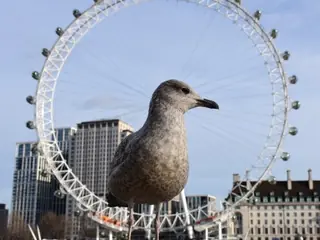 | Herring Gull migration Larus argentatus Laridae | 2.4 lb (1.1 kg) | all | day | 825 |
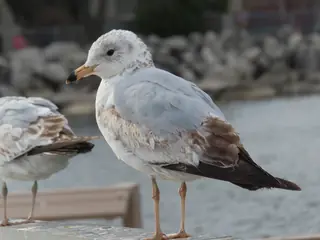 | Ring-billed Gull migration Larus delawarensis Laridae | 1.1 lb (0.5 kg) | all | day | 5,716 |
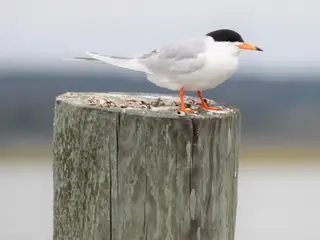 | Forster's Tern migration Sterna forsteri Laridae | 5.3 oz (149 g) | all | day | 5,332 |
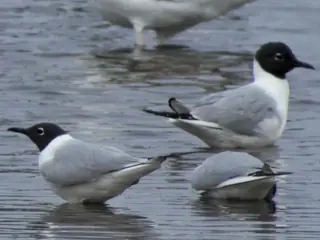 | Bonaparte's Gull migration Chroicocephalus philadelphia Laridae | 7.4 oz (211 g) | 71% | 1,721 | |
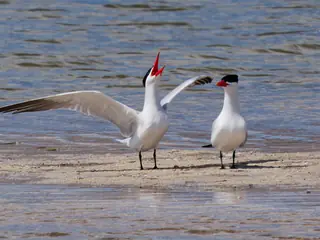 | Caspian Tern migration Hydroprogne caspia Laridae | 1.4 lb (0.7 kg) | 47% | 3,108 | |
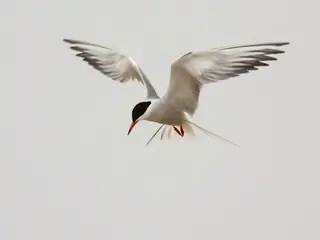 | Common Tern migration Sterna hirundo Laridae | 4.6 oz (129 g) | 35% | day | 374 |
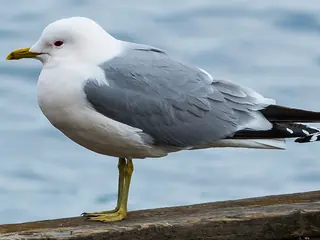 | Mew Gull winter Larus canus Laridae | 14.6 oz (412 g) | 25% | day | 77 |
| Thayer's Gull winter Larus thayeri Laridae | 2.1 lb (0.9 kg) | 18% | day | ||
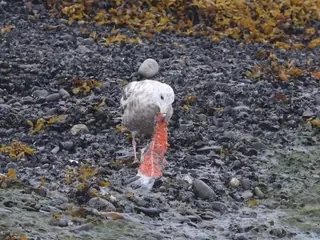 | Glaucous-winged Gull winter Larus glaucescens Laridae | 2.3 lb (1.1 kg) | 17% | day | 1,346 |
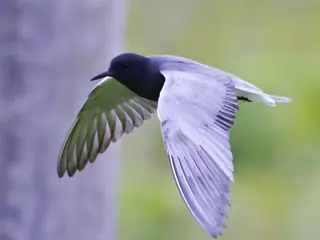 | Black Tern summer Chlidonias niger Laridae | 2.3 oz (65 g) | 15% | day | 1,236 |
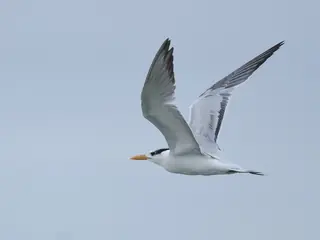 | Royal Tern winter Thalasseus maximus Laridae | 14.6 oz (415 g) | 8% | 1,051 | |
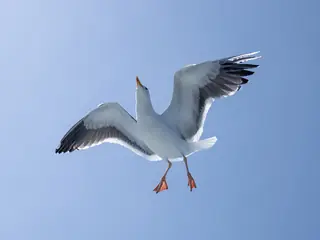 | Western Gull Larus occidentalis Laridae | 2.0 lb (0.9 kg) | 8% | day | 15,826 |
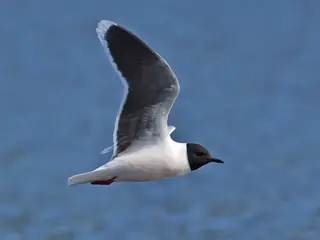 | Little Gull winter Hydrocoloeus minutus Laridae | 4.2 oz (118 g) | 8% | 6 | |
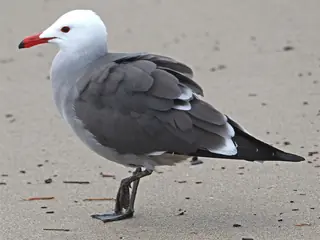 | Heermann's Gull Larus heermanni Laridae | 1.1 lb (0.5 kg) | 7% | day | 3,970 |
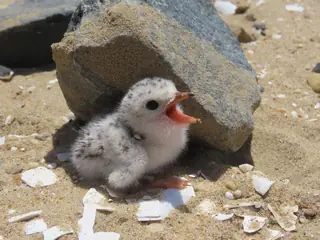 | Least Tern summer Sternula antillarum Laridae | 1.6 oz (46 g) | 6% | 68,252 | |
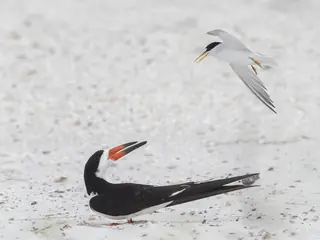 | Black Skimmer winter Rynchops niger Laridae | 10.5 oz (298 g) | 3% | day | 850 |
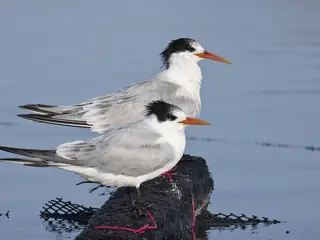 | Elegant Tern summer Thalasseus elegans Laridae | 9.2 oz (260 g) | 3% | 1,684 | |
 | Arctic Tern migration Sterna paradisaea Laridae | 3.9 oz (110 g) | 3% | day | 162 |
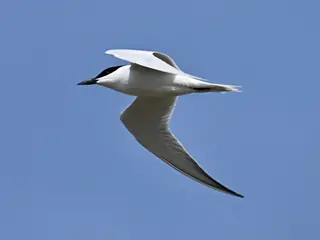 | Gull-billed Tern summer Gelochelidon nilotica Laridae | 7.7 oz (218 g) | 1% | 285 | |
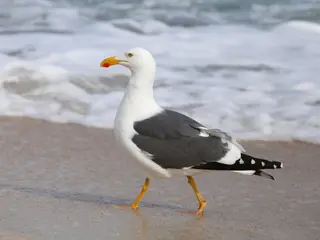 | Yellow-footed Gull Larus livens Laridae | 2.9 lb (1.3 kg) | 1% | day | 103 |
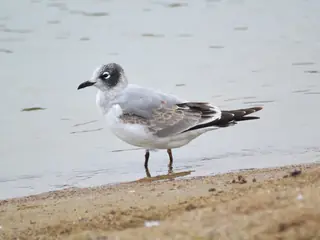 | Franklin's Gull migration Leucophaeus pipixcan Laridae | 9.9 oz (280 g) | under 1% | 54 |
Share of California is the part of the state inside the species' USGS range map. Size is the largest on record where the source gives a maximum, otherwise a typical adult. Records are open-licence observations and specimens in the state, with eBird left out; a blank means none were counted, not that the species is absent.
More California lists
Other groups in California
Gulls and terns in nearby states
Sources
- AVONET: morphological ecological and geographical data for all birds. CC BY 4.0. Read 2026-11-15.
- EltonTraits 1.0. CC0. Read 2026-11-15.
- GBIF Backbone Taxonomy. CC BY 4.0. Read 2026-11-15.
- GBIF occurrence records under CC0 and CC BY 4.0. CC0 and CC BY 4.0 per record. Read 2026-11-15.
- US Census Bureau cartographic boundary files 2023. Public domain (US Census Bureau). Read 2026-11-15.
- USGS GAP 12-digit hydrologic unit range units. Public domain (USGS). Read 2026-11-15.
- USGS Gap Analysis Project Species Range Maps CONUS_2001. Public domain (USGS). Read 2026-11-15.
- iNaturalist photographs under CC0 and CC BY. CC0 and CC BY per photograph. Read 2026-11-15.
How each figure is derived is set out on the methods page.