Gulls and terns in Florida
21 species of gulls and terns have a mapped range in Florida. 6 are mapped across the whole state, among them the Black Tern, the Bonaparte's Gull and the Common Tern.
The most restricted is the Bridled Tern, mapped in under 1% of the state.
The heaviest is the Great Black-backed Gull, at 3.6 lb (1.6 kg); the lightest is the Least Tern, at 1.6 oz (46 g).
Of these, 1 are mapped year-round, 6 in summer only, 12 in winter only and 2 on migration only.
The most species are mapped in Monroe County (18); the fewest in Baker County (7).
Open-licence records in the state (13,846 of them) peak in January and are fewest in November.
The most often recorded is the Laughing Gull, with 4,810 open-licence records in the state.
- 7 to 8
- 9 to 11
- 12 to 13
- 14 to 16
- 17 to 18
| Species | Size | Share of Florida | Active | Records | |
|---|---|---|---|---|---|
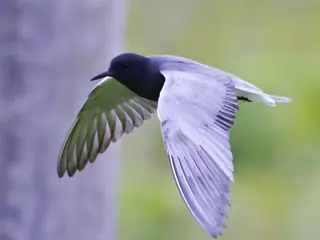 | Black Tern migration Chlidonias niger Laridae | 2.3 oz (65 g) | all | day | 242 |
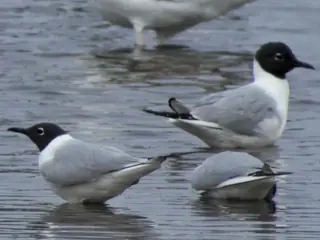 | Bonaparte's Gull winter Chroicocephalus philadelphia Laridae | 7.4 oz (211 g) | all | 379 | |
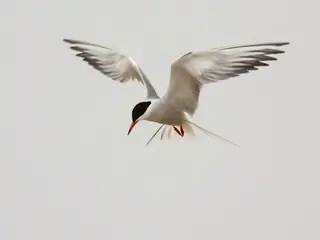 | Common Tern migration Sterna hirundo Laridae | 4.6 oz (129 g) | all | day | 268 |
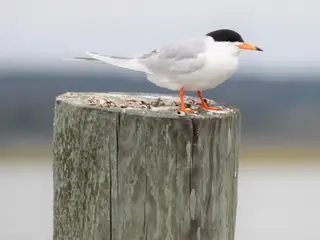 | Forster's Tern winter Sterna forsteri Laridae | 5.3 oz (149 g) | all | day | 645 |
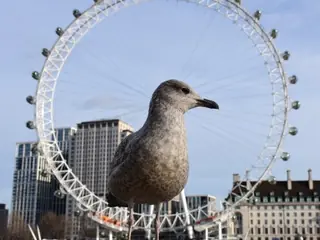 | Herring Gull winter Larus argentatus Laridae | 2.4 lb (1.1 kg) | all | day | 24 |
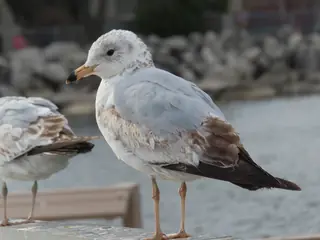 | Ring-billed Gull winter Larus delawarensis Laridae | 1.1 lb (0.5 kg) | all | day | 1,642 |
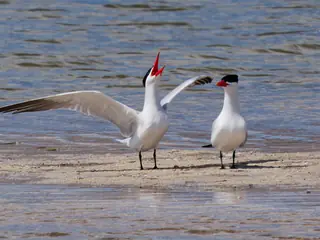 | Caspian Tern winter Hydroprogne caspia Laridae | 1.4 lb (0.7 kg) | 97% | 232 | |
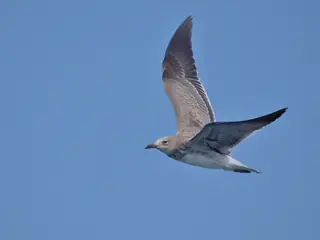 | Laughing Gull winter Leucophaeus atricilla Laridae | 10.8 oz (307 g) | 76% | 4,810 | |
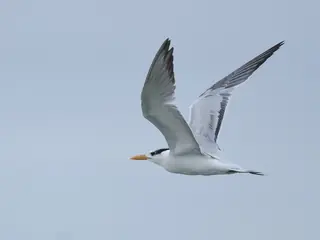 | Royal Tern winter Thalasseus maximus Laridae | 14.6 oz (415 g) | 54% | 2,258 | |
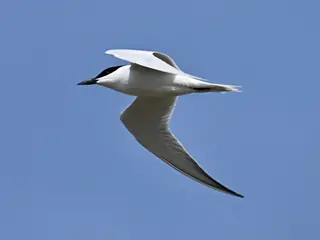 | Gull-billed Tern summer Gelochelidon nilotica Laridae | 7.7 oz (218 g) | 53% | 121 | |
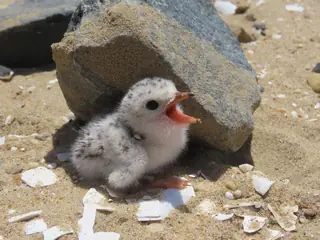 | Least Tern summer Sternula antillarum Laridae | 1.6 oz (46 g) | 42% | 966 | |
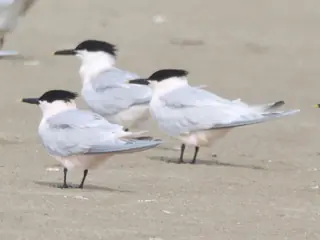 | Sandwich Tern winter Thalasseus sandvicensis Laridae | 7.0 oz (200 g) | 39% | 690 | |
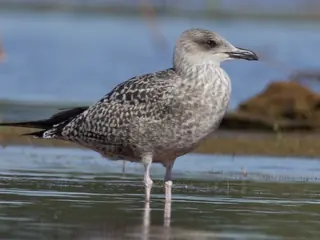 | Lesser Black-backed Gull winter Larus fuscus Laridae | 1.7 lb (0.8 kg) | 28% | day | 334 |
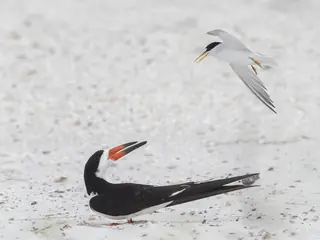 | Black Skimmer Rynchops niger Laridae | 10.5 oz (298 g) | 21% | day | 1,207 |
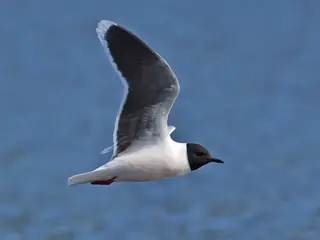 | Little Gull winter Hydrocoloeus minutus Laridae | 4.2 oz (118 g) | 16% | 1 | |
| Thayer's Gull winter Larus thayeri Laridae | 2.1 lb (0.9 kg) | 15% | day | ||
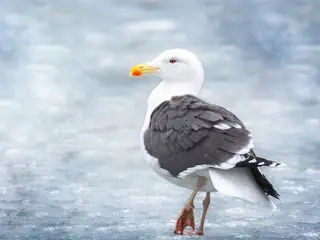 | Great Black-backed Gull winter Larus marinus Laridae | 3.6 lb (1.6 kg) | 4% | day | 67 |
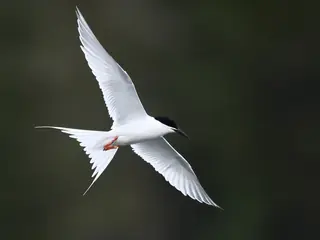 | Roseate Tern summer Sterna dougallii Laridae | 4.0 oz (112 g) | under 1% | day | 1,403 |
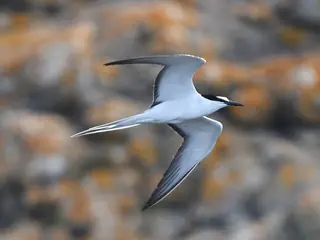 | Bridled Tern summer Onychoprion anaethetus Laridae | 4.2 oz (119 g) | under 1% | 69 | |
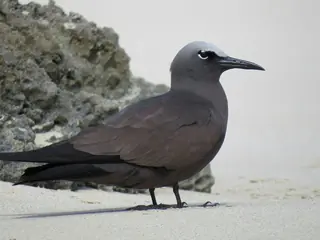 | Brown Noddy summer Anous stolidus Laridae | 6.3 oz (178 g) | under 1% | day | 217 |
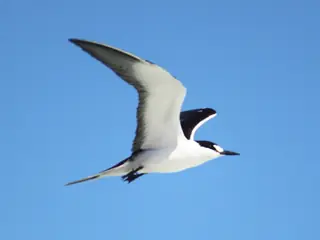 | Sooty Tern summer Onychoprion fuscatus Laridae | 6.6 oz (186 g) | under 1% | 474 |
Share of Florida is the part of the state inside the species' USGS range map. Size is the largest on record where the source gives a maximum, otherwise a typical adult. Records are open-licence observations and specimens in the state, with eBird left out; a blank means none were counted, not that the species is absent.
More Florida lists
Other groups in Florida
Gulls and terns in nearby states
Sources
- AVONET: morphological ecological and geographical data for all birds. CC BY 4.0. Read 2026-11-15.
- EltonTraits 1.0. CC0. Read 2026-11-15.
- GBIF Backbone Taxonomy. CC BY 4.0. Read 2026-11-15.
- GBIF occurrence records under CC0 and CC BY 4.0. CC0 and CC BY 4.0 per record. Read 2026-11-15.
- US Census Bureau cartographic boundary files 2023. Public domain (US Census Bureau). Read 2026-11-15.
- USGS GAP 12-digit hydrologic unit range units. Public domain (USGS). Read 2026-11-15.
- USGS Gap Analysis Project Species Range Maps CONUS_2001. Public domain (USGS). Read 2026-11-15.
- iNaturalist photographs under CC0 and CC BY. CC0 and CC BY per photograph. Read 2026-11-15.
How each figure is derived is set out on the methods page.