Lizards in Mississippi
11 species of lizards have a mapped range in Mississippi. 5 are mapped across the whole state, among them the Eastern Fence Lizard, the Green Anole and the Little Brown Skink.
The most restricted is the Mimic Glass Lizard, mapped in 15% of the state.
The heaviest is the Slender Glass Lizard, at 5.2 oz (148 g); the lightest is the Little Brown Skink, at 0.1 oz (3.9 g).
The most species are mapped in Wayne County (11); the fewest in Bolivar County (6).
Open-licence records in the state (1,742 of them) peak in April and are fewest in December.
The most often recorded is the Eastern Fence Lizard, with 731 open-licence records in the state.
By the trait records, 9 are active by day and 2 are active by day and by night.
They belong to 5 families; the largest here is Scincidae, with 5 species.
- 6
- 7
- 8 to 9
- 10
- 11
| Species | Size | Share of Mississippi | Active | Records | |
|---|---|---|---|---|---|
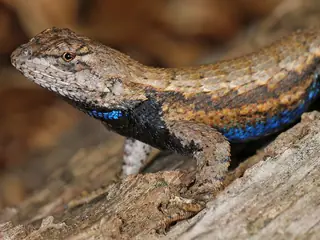 | Eastern Fence Lizard Sceloporus undulatus Phrynosomatidae | 3.6 in (91 mm) snout to vent | all | day | 731 |
 | Green Anole Anolis carolinensis Dactyloidae | 3.0 in (75 mm) snout to vent | all | day | 512 |
 | Little Brown Skink Scincella lateralis Scincidae | 2.3 in (59 mm) snout to vent | all | day | 400 |
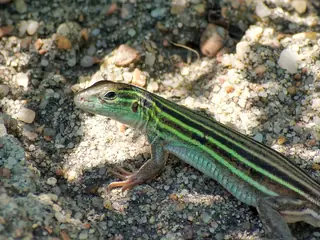 | Six-lined Racerunner Aspidoscelis sexlineatus Teiidae | 3.6 in (91 mm) snout to vent | all | day | 151 |
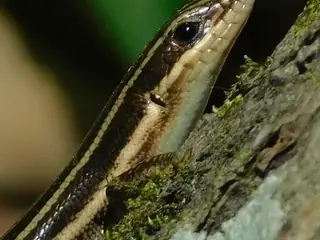 | Common Five-lined Skink Plestiodon fasciatus Scincidae | 3.4 in (86 mm) snout to vent | all | day | 254 |
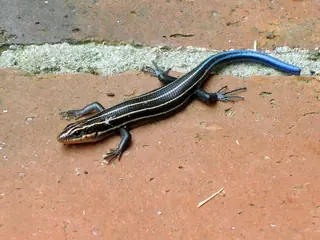 | Broad-headed Skink Plestiodon laticeps Scincidae | 5.6 in (143 mm) snout to vent | 99% | day | 53 |
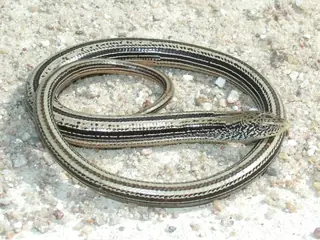 | Slender Glass Lizard Ophisaurus attenuatus Anguidae | 14 in (359 mm) snout to vent | 87% | day | 39 |
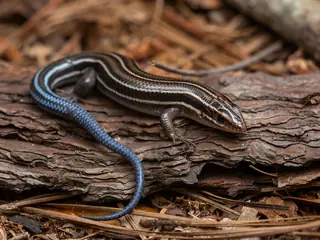 | Southeastern Five-lined Skink Plestiodon inexpectatus Scincidae | 3.5 in (89 mm) snout to vent | 79% | day | 170 |
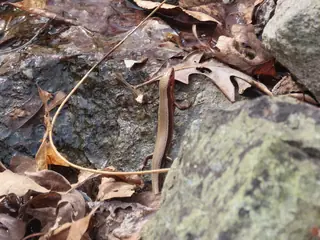 | Coal Skink Plestiodon anthracinus Scincidae | 2.8 in (70 mm) snout to vent | 46% | day | 14 |
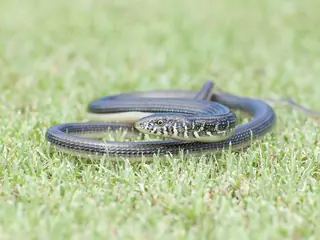 | Eastern Glass Lizard Ophisaurus ventralis Anguidae | 12 in (306 mm) snout to vent | 30% | day and night | 71 |
| Mimic Glass Lizard Ophisaurus mimicus Anguidae | 7.2 in (183 mm) snout to vent | 15% | day and night |
Share of Mississippi is the part of the state inside the species' USGS range map. Size is the largest on record where the source gives a maximum, otherwise a typical adult. Records are open-licence observations and specimens in the state; a blank means none were counted, not that the species is absent.
More Mississippi lists
Other groups in Mississippi
Lizards in nearby states
Sources
- GBIF Backbone Taxonomy. CC BY 4.0. Read 2026-11-15.
- GBIF occurrence records under CC0 and CC BY 4.0. CC0 and CC BY 4.0 per record. Read 2026-11-15.
- ReptTraits v1.2. CC BY 4.0. Read 2026-11-15.
- US Census Bureau cartographic boundary files 2023. Public domain (US Census Bureau). Read 2026-11-15.
- USGS GAP 12-digit hydrologic unit range units. Public domain (USGS). Read 2026-11-15.
- USGS Gap Analysis Project Species Range Maps CONUS_2001. Public domain (USGS). Read 2026-11-15.
- iNaturalist photographs under CC0 and CC BY. CC0 and CC BY per photograph. Read 2026-11-15.
How each figure is derived is set out on the methods page.