Salamanders in Louisiana
23 species of salamanders have a mapped range in Louisiana. The most widespread is the Three-toed Amphiuma, mapped across all of the state.
The most restricted is the Webster's Salamander, mapped in under 1% of the state.
The longest is the Two-toed Amphiuma, at 3.8 ft (1,162 mm); the shortest is the Webster's Salamander, at 3.2 in (82 mm).
The most species are mapped in Washington Parish (19); the fewest in Plaquemines Parish (5).
Open-licence records in the state (7,927 of them) peak in March and are fewest in August.
The most often recorded is the Dwarf Salamander, with 1,548 open-licence records in the state.
They belong to 6 families; the largest here is Plethodontidae, with 12 species.
- 5 to 7
- 8 to 9
- 10 to 12
- 13 to 14
- 15 to 19
| Species | Size | Share of Louisiana | Active | Records | |
|---|---|---|---|---|---|
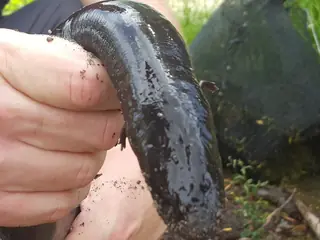 | Three-toed Amphiuma Amphiuma tridactylum Amphiumidae | 3.5 ft (1,060 mm) body | all | 578 | |
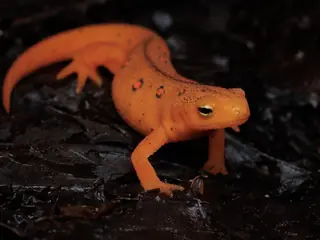 | Eastern Newt Notophthalmus viridescens Salamandridae | 5.5 in (140 mm) body | 97% | 1,018 | |
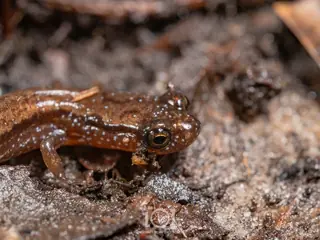 | Dwarf Salamander Eurycea quadridigitata Plethodontidae | 3.5 in (90 mm) body | 96% | day | 1,548 |
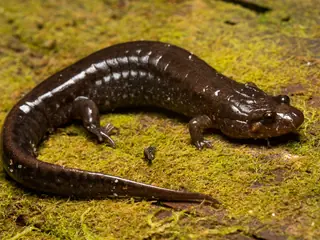 | Spotted Dusky Salamander Desmognathus conanti Plethodontidae | 88% | 49 | ||
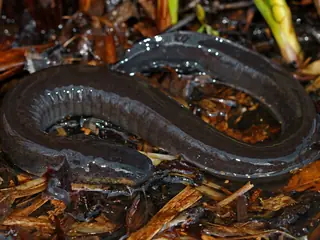 | Lesser Siren Siren intermedia Sirenidae | 2.3 ft (686 mm) body | 82% | night | 318 |
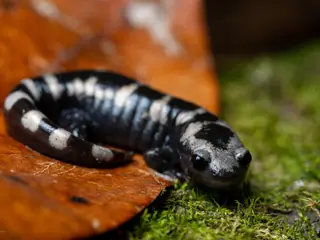 | Marbled Salamander Ambystoma opacum Ambystomatidae | 5.0 in (127 mm) body | 76% | 1,398 | |
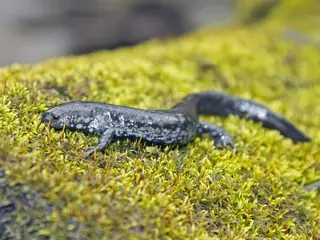 | Small-mouthed Salamander Ambystoma texanum Ambystomatidae | 7.0 in (178 mm) body | 70% | 1,114 | |
| Southern Dusky Salamander Desmognathus auriculatus Plethodontidae | 6.4 in (163 mm) body | 65% | 705 | ||
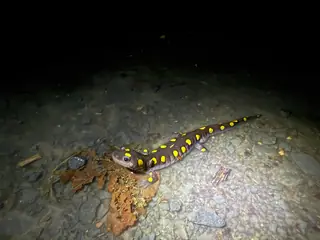 | Spotted Salamander Ambystoma maculatum Ambystomatidae | 9.8 in (248 mm) body | 63% | day | 662 |
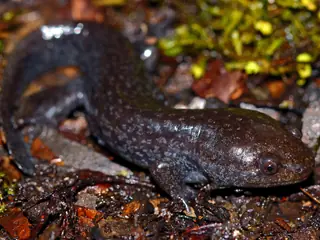 | Mole Salamander Ambystoma talpoideum Ambystomatidae | 4.8 in (122 mm) body | 55% | day | 237 |
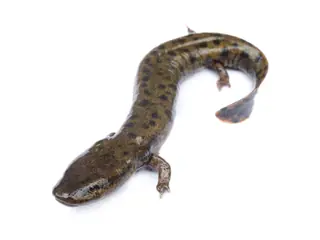 | Mudpuppy Necturus maculosus Proteidae | 19 in (486 mm) body | 29% | night | 52 |
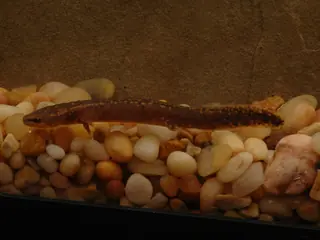 | Gulf Coast Waterdog Necturus beyeri Proteidae | 8.7 in (222 mm) body | 26% | 409 | |
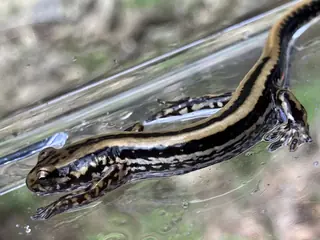 | Three-lined Salamander Eurycea guttolineata Plethodontidae | 5.5 in (140 mm) body | 15% | 134 | |
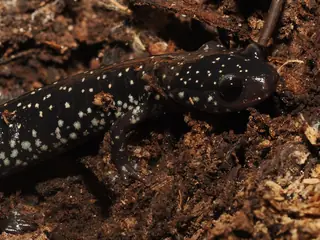 | Mississippi Slimy Salamander Plethodon mississippi Plethodontidae | 6.4 in (164 mm) body | 14% | 981 | |
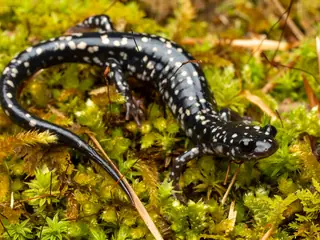 | Louisiana Slimy Salamander Plethodon kisatchie Plethodontidae | 5.6 in (143 mm) body | 12% | 87 | |
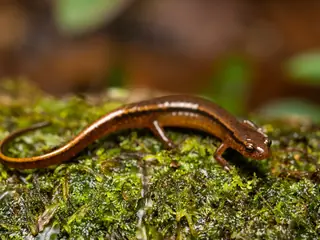 | Southern Two-lined Salamander Eurycea cirrigera Plethodontidae | 11% | 242 | ||
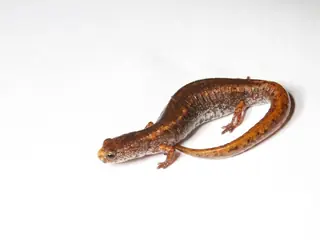 | Four-toed Salamander Hemidactylium scutatum Plethodontidae | 4.7 in (120 mm) body | 7% | 10 | |
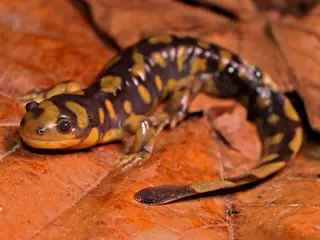 | Eastern Tiger Salamander Ambystoma tigrinum Ambystomatidae | 13 in (330 mm) body | 7% | 27 | |
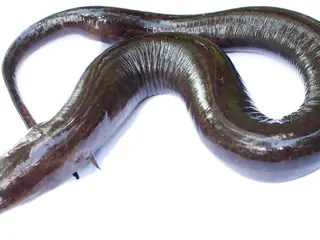 | Two-toed Amphiuma Amphiuma means Amphiumidae | 3.8 ft (1,162 mm) body | 6% | 74 | |
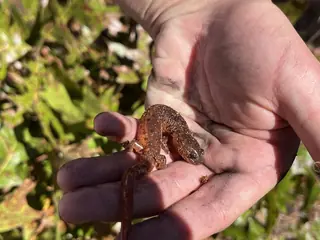 | Mud Salamander possible Pseudotriton montanus Plethodontidae | 8.1 in (207 mm) body | 4% | 19 | |
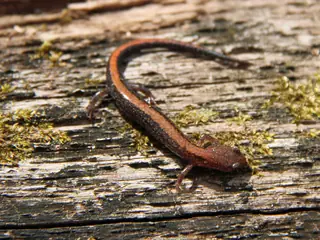 | Southern Red-backed Salamander Plethodon serratus Plethodontidae | 4.1 in (105 mm) body | 4% | 204 | |
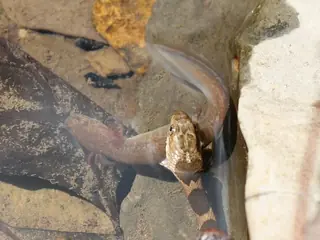 | Red Salamander Pseudotriton ruber Plethodontidae | 7.1 in (181 mm) body | 2% | 53 | |
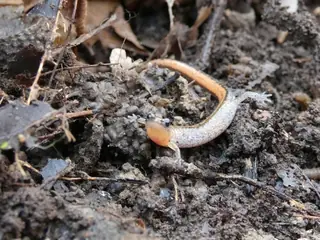 | Webster's Salamander Plethodon websteri Plethodontidae | 3.2 in (82 mm) body | under 1% | 6 |
Share of Louisiana is the part of the state inside the species' USGS range map. Size is the largest on record where the source gives a maximum, otherwise a typical adult. Records are open-licence observations and specimens in the state; a blank means none were counted, not that the species is absent.
Other groups in Louisiana
Salamanders in nearby states
Sources
- AmphiBIO v1. CC BY 4.0. Read 2026-11-15.
- GBIF Backbone Taxonomy. CC BY 4.0. Read 2026-11-15.
- GBIF occurrence records under CC0 and CC BY 4.0. CC0 and CC BY 4.0 per record. Read 2026-11-15.
- US Census Bureau cartographic boundary files 2023. Public domain (US Census Bureau). Read 2026-11-15.
- USGS GAP 12-digit hydrologic unit range units. Public domain (USGS). Read 2026-11-15.
- USGS Gap Analysis Project Species Range Maps CONUS_2001. Public domain (USGS). Read 2026-11-15.
- iNaturalist photographs under CC0 and CC BY. CC0 and CC BY per photograph. Read 2026-11-15.
How each figure is derived is set out on the methods page.