Squirrels and chipmunks in Washington
21 species of squirrels and chipmunks have a mapped range in Washington. The most widespread is the Northern Flying Squirrel, mapped across 68% of the state.
The most restricted is the Belding's Ground Squirrel, mapped in under 1% of the state.
The longest is the Hoary Marmot, at 24 in (600 mm); the shortest is the Least Chipmunk, at 4.4 in (112 mm).
USGS marks 2 of them as introduced in the state: the Eastern Gray Squirrel and the Eastern Fox Squirrel.
The most species are mapped in Yakima County (11); the fewest in San Juan County (1).
Open-licence records in the state (11,417 of them) peak in August and are fewest in January.
The most often recorded is the Townsend's Chipmunk, with 2,446 open-licence records in the state.
By the trait records, 20 are active by day and 1 is active at night.
- 1 to 3
- 4 to 5
- 6 to 7
- 8 to 9
- 10 to 11
| Species | Size | Share of Washington | Active | Records | |
|---|---|---|---|---|---|
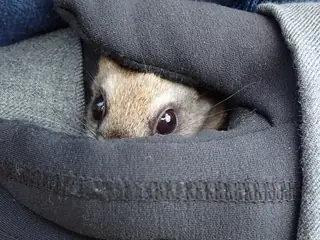 | Northern Flying Squirrel Glaucomys sabrinus Sciuridae | 11 in (268 mm) body | 68% | night | 609 |
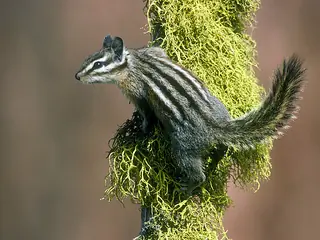 | Yellow-pine Chipmunk Tamias amoenus Sciuridae | 4.6 in (118 mm) body | 62% | day | 2,430 |
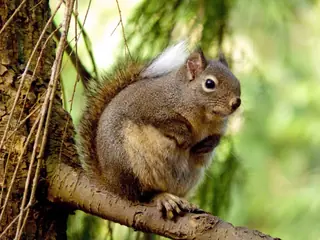 | Douglas's Squirrel Tamiasciurus douglasii Sciuridae | 9.1 in (230 mm) body | 52% | day | 1,765 |
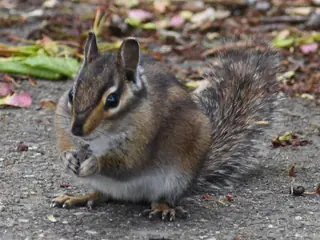 | Townsend's Chipmunk Tamias townsendii Sciuridae | 5.5 in (139 mm) body | 47% | day | 2,446 |
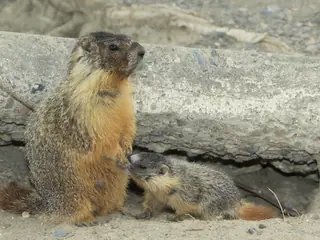 | Yellow-bellied Marmot Marmota flaviventris Sciuridae | 20 in (506 mm) body | 46% | day | 231 |
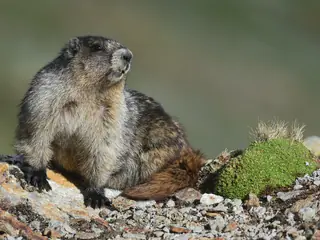 | Hoary Marmot Marmota caligata Sciuridae | 24 in (600 mm) body | 34% | day | 432 |
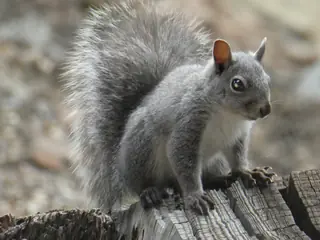 | Western Gray Squirrel Sciurus griseus Sciuridae | 12 in (293 mm) body | 31% | day | 236 |
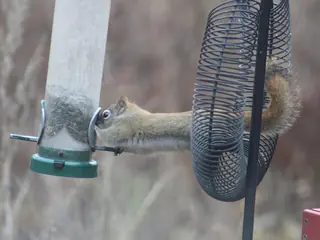 | Red Squirrel Tamiasciurus hudsonicus Sciuridae | 7.5 in (190 mm) body | 30% | day | 548 |
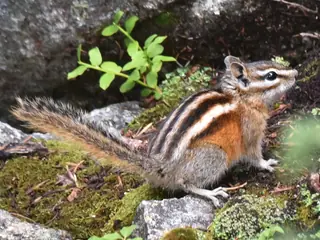 | Least Chipmunk possible Tamias minimus Sciuridae | 4.4 in (112 mm) body | 27% | day | 195 |
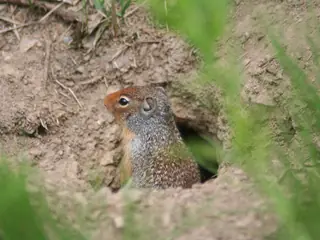 | Columbian Ground Squirrel Urocitellus columbianus Sciuridae | 14 in (351 mm) body | 25% | day | 268 |
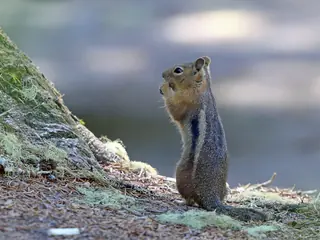 | Cascade Golden-mantled Ground Squirrel Callospermophilus saturatus Sciuridae | 12 in (310 mm) body | 22% | day | 479 |
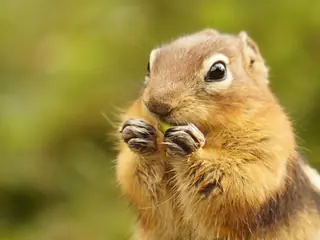 | Golden-mantled Ground Squirrel Callospermophilus lateralis Sciuridae | 12 in (310 mm) body | 15% | day | 72 |
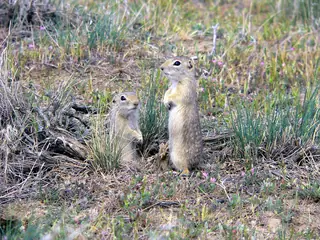 | Washington Ground Squirrel Urocitellus washingtoni Sciuridae | 11 in (286 mm) body | 9% | day | 249 |
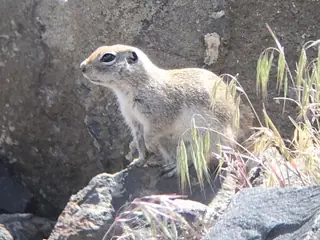 | Townsend's Ground Squirrel Urocitellus townsendii Sciuridae | 11 in (290 mm) body | 9% | day | 269 |
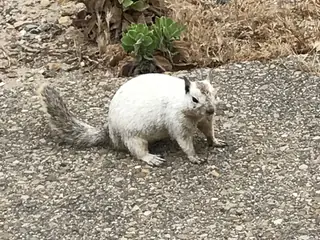 | California Ground Squirrel Otospermophilus beecheyi Sciuridae | 14 in (366 mm) body | 8% | day | 56 |
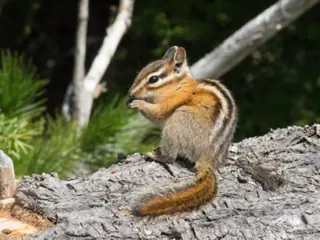 | Red-tailed Chipmunk Tamias ruficaudus Sciuridae | 4.9 in (124 mm) body | 6% | day | 142 |
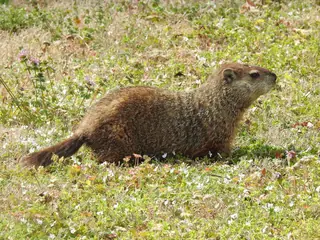 | Woodchuck Marmota monax Sciuridae | 20 in (506 mm) body | 6% | day | 1 |
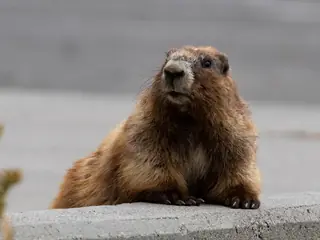 | Olympic Marmot Marmota olympus Sciuridae | 24 in (600 mm) body | 4% | day | 164 |
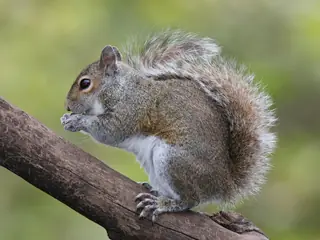 | Eastern Gray Squirrel introducedpossible Sciurus carolinensis Sciuridae | 12 in (315 mm) body | 2% | day | 981 |
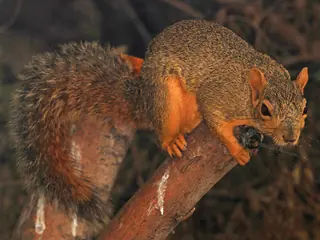 | Eastern Fox Squirrel introducedpossible Sciurus niger Sciuridae | 16 in (418 mm) body | under 1% | day | 98 |
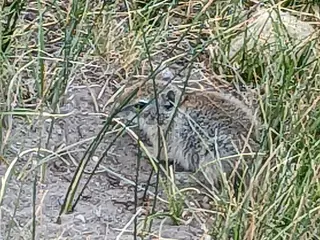 | Belding's Ground Squirrel Urocitellus beldingi Sciuridae | 13 in (321 mm) body | under 1% | day |
Share of Washington is the part of the state inside the species' USGS range map. Size is the largest on record where the source gives a maximum, otherwise a typical adult. Records are open-licence observations and specimens in the state; a blank means none were counted, not that the species is absent.
Other groups in Washington
Squirrels and chipmunks in nearby states
Sources
- COMBINE: a coalesced mammal database of intrinsic and extrinsic traits. CC BY 4.0. Read 2026-11-15.
- EltonTraits 1.0. CC0. Read 2026-11-15.
- GBIF Backbone Taxonomy. CC BY 4.0. Read 2026-11-15.
- GBIF occurrence records under CC0 and CC BY 4.0. CC0 and CC BY 4.0 per record. Read 2026-11-15.
- PanTHERIA 1.0. CC0. Read 2026-11-15.
- US Census Bureau cartographic boundary files 2023. Public domain (US Census Bureau). Read 2026-11-15.
- USGS GAP 12-digit hydrologic unit range units. Public domain (USGS). Read 2026-11-15.
- USGS Gap Analysis Project Species Range Maps CONUS_2001. Public domain (USGS). Read 2026-11-15.
- iNaturalist photographs under CC0 and CC BY. CC0 and CC BY per photograph. Read 2026-11-15.
How each figure is derived is set out on the methods page.