Ferruginous Hawk
Buteo regalis
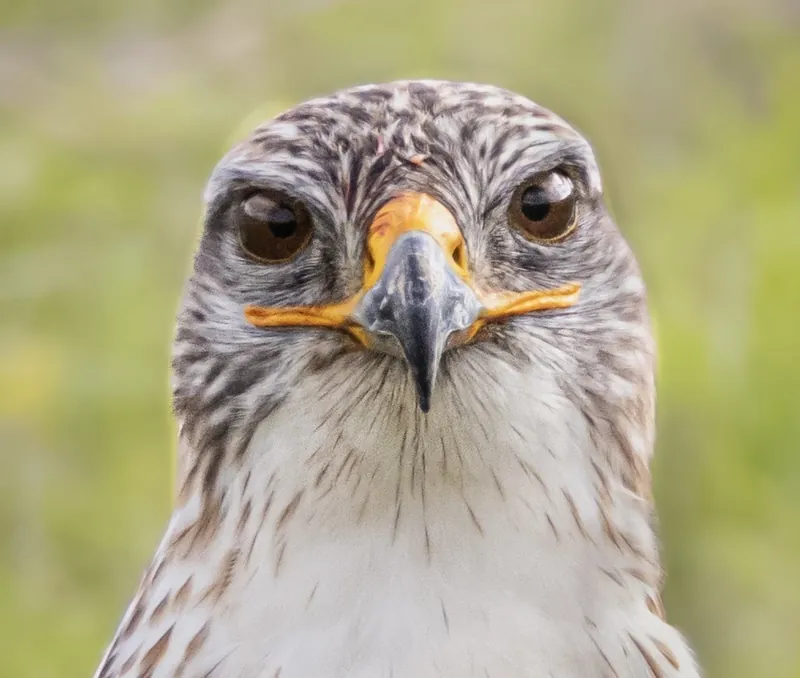
The Ferruginous Hawk (Buteo regalis) is a bird in the family Accipitridae. USGS maps its range in 17 of the lower 48 states, and in 3 of them it covers the whole state. Adults weigh about 3.2 lb (1.4 kg).
Its mapped range is split between seasons: 39% summer, 37% winter and 23% year-round.
It is active by day. It eats mainly other animals. AVONET classes it as a migrant.
The USGS habitat model maps it across 144 land-cover types. The model places it no higher than 2,895 m (9,500 ft).
Open-licence records from the lower 48 (2,208 of them) peak in May and are fewest in July. A typical clutch is about 3.8. The longest recorded lifespan is 23.7 years.
Where the Ferruginous Hawk lives
| State | Share of state | Counties | Open records | Peak month |
|---|---|---|---|---|
| Arizona | all | 15 of 15 | 113 | January |
| Nevada winter | all | 17 of 17 | 38 | |
| Wyoming summer | all | 23 of 23 | 63 | May |
| New Mexico | 99% | 33 of 33 | 164 | November |
| California winter | 97% | 58 of 58 | 525 | January |
| Utah summer | 95% | 29 of 29 | 113 | April |
| Colorado | 94% | 60 of 64 | 221 | January |
| South Dakota summer | 87% | 55 of 66 | 33 | |
| Montana summer | 82% | 48 of 56 | 113 | May |
| Idaho summer | 73% | 41 of 44 | 25 | |
| North Dakota summer | 68% | 36 of 53 | 358 | May |
| Nebraska summer | 57% | 41 of 93 | 52 | March |
| Texas winter | 57% | 129 of 254 | 171 | January |
| Oregon summer | 53% | 14 of 36 | 149 | April |
| Kansas winter | 52% | 52 of 105 | 142 | December |
| Oklahoma winter | 44% | 32 of 77 | 50 | December |
| Washington summer | 38% | 20 of 39 | 62 | April |
Share of state is the part of each state inside the range map. Counties counts those with at least a tenth of their area in range. A state link opens that state's full list.
When it is recorded
Sources
- AVONET: morphological ecological and geographical data for all birds. CC BY 4.0. Read 2026-11-15.
- Amniote life-history database. CC0. Read 2026-11-15.
- EltonTraits 1.0. CC0. Read 2026-11-15.
- GBIF Backbone Taxonomy. CC BY 4.0. Read 2026-11-15.
- GBIF occurrence records under CC0 and CC BY 4.0. CC0 and CC BY 4.0 per record. Read 2026-11-15.
- Integrated Taxonomic Information System. CC0. Read 2026-11-15.
- US Census Bureau cartographic boundary files 2023. Public domain (US Census Bureau). Read 2026-11-15.
- USGS GAP 12-digit hydrologic unit range units. Public domain (USGS). Read 2026-11-15.
- USGS Gap Analysis Project Species Habitat Maps CONUS_2001 (model parameters). Public domain (USGS). Read 2026-11-15.
- USGS Gap Analysis Project Species Range Maps CONUS_2001. Public domain (USGS). Read 2026-11-15.
- iNaturalist photographs under CC0 and CC BY. CC0 and CC BY per photograph. Read 2026-11-15.
How each figure is derived is set out on the methods page.